9.8.26
The End of Waiting at Work
Read
.svg)
.svg)
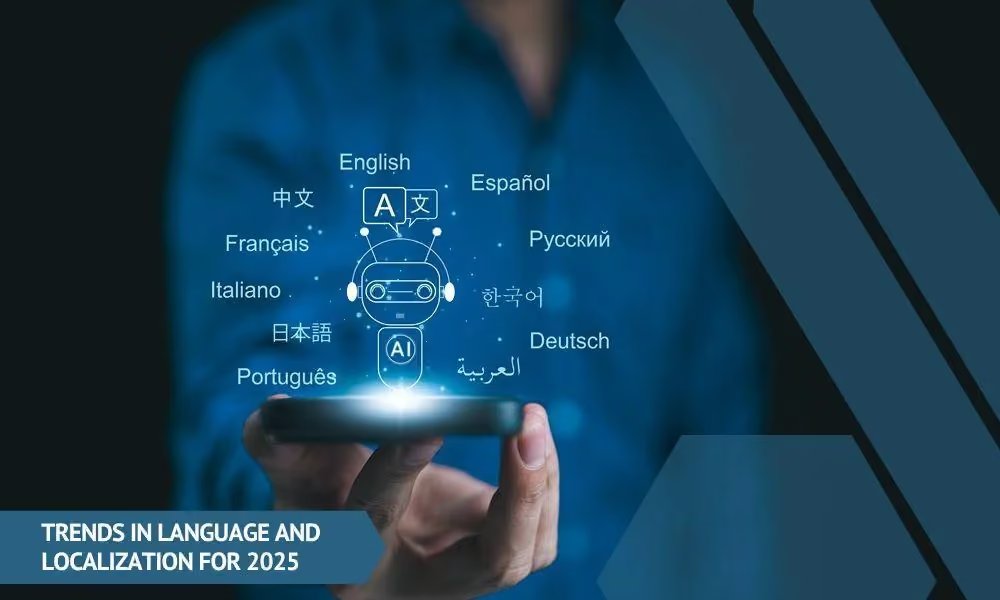
As 2025 quickly approaches, the language services industrystands on the cusp of groundbreaking innovations. New technologies, evolvingconsumer expectations, and global interconnectivity are driving change at anunprecedented pace. Powerling has identified key trends that will shape thefuture of language and localization, helping organizations bridge cultural gapsand connect meaningfully with their audiences. Below, we delve deeper into 9 ofthese trends and their implications for businesses.
AI-driven platforms are revolutionizing language learning byoffering interactive and adaptive solutions tailored to individual users. Thesetools provide instant feedback, identify common errors, and personalizelearning paths in real time. For example, AI in platforms like Duolingopredicts the difficulty of exercises based on a learner's progress to ensuresteady improvement.
Use Case: A multinational company deploying anAI-powered training program for employees across regions can ensure consistentlanguage skills, tailored to the nuances of local dialects. Tools like theseare also aiding refugee integration programs, teaching essential communicationskills in host countries.
Machine learning enables platforms to dynamically adaptcontent based on user behaviors and preferences, creating hyper-personalizedlearning journeys. A medical translation training tool, for instance, mightfocus on technical terminology for healthcare professionals while simplifyingsyntax for administrative staff.
Use Case: An e-commerce company with a diverse globalworkforce could use machine learning-based modules to teach localized customerservice phrases, helping employees address regional customer expectationseffectively.
VR and AR create immersive environments for languagelearners, simulating real-world scenarios to enhance conversational skills. Forinstance, a user might virtually practice Arabic phrases in a Moroccan marketor navigate a job interview in Mandarin.
Use Case: Hospitality chains are using VR to trainemployees in customer interactions specific to different regions, such as howto welcome guests in Japanese versus Spanish. Educational institutions areincorporating AR to overlay translations onto physical objects, teachingvocabulary in an interactive way.
Conversational AI has become a staple for language practice,offering lifelike interactions through chatbots and virtual assistants. Thesetools provide learners with an accessible way to hone conversational skills andindustry-specific terminology.
Use Case: Customer support teams in global companies can train withconversational AI tailored to their specific industries, such as practicingproduct-specific dialogues in German or resolving common troubleshooting issuesin Portuguese.
Gamified learning apps make language acquisition fun andinteractive. Features like leaderboards, rewards, and storytelling engagelearners of all ages and skill levels. Duolingo and Babbel have alreadypopularized this trend, but newer platforms are integrating deeper mechanics,such as role-playing scenarios and real-world tasks.
Use Case: A healthcare provider could gamify training modules,encouraging employees to master medical terminology through interactive quizzesand rewards for high scores. This method ensures engagement while improvingknowledge retention.
Multimodal translation integrates text, audio, video, andimages to provide contextually accurate communication. Localizing a productvideo, for example, might involve adapting scripts, re-recording voiceovers,and modifying visuals to align with regional preferences.
Use Case: E-commerce platforms that sell internationally areincreasingly adopting multimodal translations for product pages, integratinglocalized videos, infographics, and audio descriptions to better connect withtheir audiences.
Localization goes beyond translation, adapting content toalign with cultural preferences and expectations. This includes modifyingcolors, idioms, humor, and even product design. For example, a campaign thatresonates in the U.S. might need entirely different messaging to succeed inJapan.
Use Case: A global beverage brand may need to change advertising slogansor packaging design for certain countries where original content could bemisinterpreted or offensive due to cultural differences.
Businesses are leveraging data analytics to guidelocalization efforts. Predictive tools identify trends, while A/B testingrefines content for maximum engagement. For example, e-commerce companies useanalytics to optimize product pages for different markets.
Use Case: A streaming service could use viewer data to localizesubtitles, dubbing, and recommendations based on regional viewing habits. Forinstance, promoting romantic comedies in Latin America while highlightingthrillers in Scandinavia.
As sustainability becomes a global priority, localizationworkflows are evolving to minimize environmental impact. Cloud-basedcollaboration tools, reduced travel, and paperless processes are becoming thenorm.
Use Case: A global consulting firm might use virtual platforms formultilingual training sessions, reducing the need for printed materials andextensive travel, contributing to their sustainability goals while maintainingefficiency.
While technology plays a transformative role in shapinglanguage services, human oversight remains critical. Translators and linguistsbring cultural intelligence, empathy, and expertise to ensure accuracy andauthenticity that machines cannot replicate.
In localization, for instance, the subtlety of culturalnuances often goes beyond the capabilities of AI. A gesture in a marketingvideo or an idiom in a translated text may carry unintended meanings in certainregions. Human oversight ensures these elements are correctly adapted toresonate with the local audience. Similarly, in multimodal translation, humanexperts validate the coherence between text, audio, and visuals, ensuringconsistency across formats.
Even in areas like AI-powered tools, linguists ensure thatcontent is accurate and culturally relevant, especially in regions with diversedialects and customs. Without this layer of expertise, the risk ofmiscommunication or cultural missteps can increase, potentially harming brandtrust.
Ultimately, the synergy between human expertise andtechnology ensures that language and localization efforts are effective,engaging, and culturally sensitive.
These trends reveal an exciting future for the languageservices industry, where technology and human expertise work hand-in-hand todeliver impactful solutions.
At Powerling, we blend cutting-edge technology with theexpertise of our linguists to help businesses thrive in a globalized world.Contact us today to learn how our tailored solutions can empower your languageand localization strategies for 2025 and beyond.
If your organization is investing heavily in content but lacks full visibility, alignment, or scalability, it is time for a structured assessment.


.svg)


.svg)

.svg)





.svg)