.webp)
10.1.26
When AI Has to Slow Down | Carola Hahn-Auer and Ian Zhang
Read
Life Science
.svg)
.svg)
How organizations can master the language knowledge they already own and give AI the context it needs to communicate reliably at scale.
Most global organizations are already sitting on years of valuable language knowledge: content created, terminology, product information, local-market adaptations, expert corrections and approved translations through significant investment.
Yet the same problem keeps resurfacing in conversations with global content and localization teams: much of that knowledge is difficult to find, difficult to own and difficult to reuse. Organizations often end up recreating, retranslating, or reviewing information they have already paid to produce.
Generative AI makes the problem more urgent. Content can now be created, translated, and adapted faster than organizations can govern it. A single source can generate dozens of language versions, summaries, personalized messages, support articles, or other derivatives. At the same time, some of the most valuable content created before the AI era risks disappearing beneath a rapidly growing volume of new material.
But AI also creates an opportunity. The knowledge organizations have accumulated over decades is exactly the context AI systems need to become useful in an enterprise environment.
Organizations therefore need infrastructure capable of doing two things:
We use the term Language Lake for this architecture.
The concept takes inspiration from the data lake in enterprise IT, but applies it specifically to language and multilingual knowledge.
A Language Lake is a governed, continuously enriched layer that connects an organization’s monolingual and multilingual content with the context required to understand, trace and reuse it. This includes terminology, metadata, provenance, approvals, human feedback, market knowledge, regulatory rules, and the relationships between different versions, languages and transformations.
Its value comes from these relationships. A translation is not stored only as text, but connected to its source, the product or market it relates to, the terminology and rules that applied, the people or systems that approved it, and the transformations that produced it.
The Language Lake can also connect different representations of the same underlying knowledge. A product may be represented through structured data in a PIM, marketing content in a CMS, images and video in a DAM, technical documentation in a document repository, and multiple translated or adapted versions. The Language Lake preserves the multilingual relationships and context across these systems.
This makes that knowledge usable by translation workflows, AI applications, enterprise search, content generation, personalization, regulatory processes and other multilingual applications.
A Language Lake does not necessarily require a separate physical data lake. It can build on existing enterprise data infrastructure or operate alongside it, while PIM, CMS, DAM and other platforms continue to serve as systems of record for their respective content domains.
The possible applications of a Language Lake are extensive, but they come back to two fundamental purposes: mastering the language knowledge the organization already possesses, and activating that knowledge as context for what it creates next.
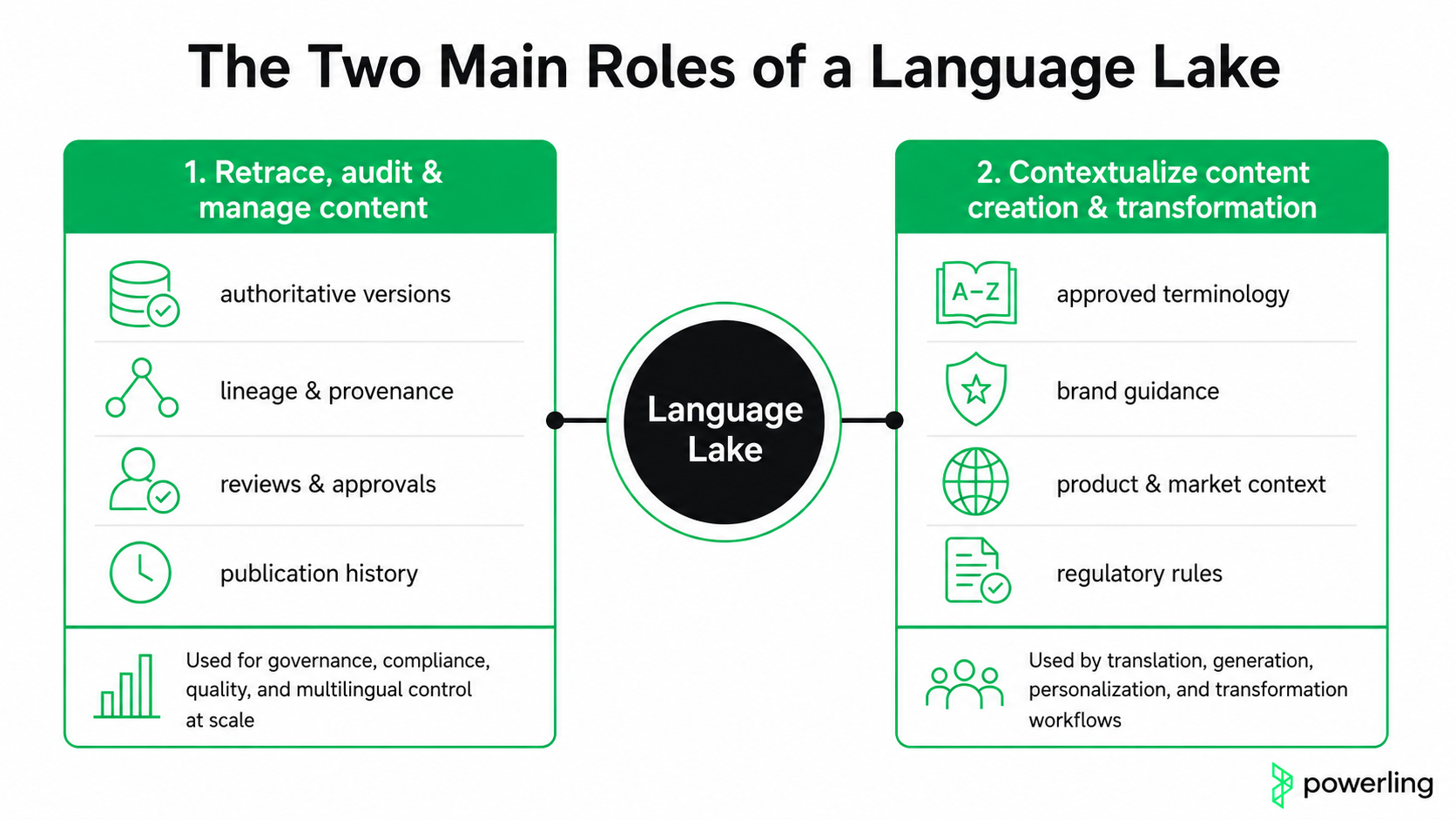
Organizations have spent years producing valuable content, often through specialist and human-led processes.
Yet many still struggle to answer seemingly simple questions:
As content volumes increase, these questions become progressively harder to answer.
And the need for traceability is becoming even more important as AI enters enterprise content workflows. Organizations increasingly need visibility into which content has been generated or transformed by AI, which models and sources were involved, and what human or automated approvals were applied. Regulations such as the EU AI Act are already introducing transparency obligations for certain uses of AI-generated and manipulated content.
The consequence goes beyond inefficiency. Organizations repeatedly recreate, retranslate, and review information because they cannot confidently reuse what they already own. Poor traceability can also lead to delayed launches, monetary loss, legal exposure, reputational damage and, in safety-critical environments, much more serious consequences.
Sometimes a single word matters. A mistranslated safety instruction, an incorrect technical term or an inaccurate sustainability claim can materially change the meaning and risk associated with content.
A Language Lake preserves the relationships between sources, versions, approvals, languages, people, systems and transformations so that the organization can reconstruct how an output came to exist.
Existing language knowledge becomes discoverable, traceable, and governable instead of disappearing inside a growing mass of content.
Generative AI can produce fluent content very quickly. Fluency does not mean that a general-purpose model understands how a particular organization needs to communicate.
AI systems are often blamed for producing the wrong output when the deeper problem is that they were never given enough information to know what the right output was.
A model cannot reliably guess which term your engineers approved, which product description is current, which claim legal has cleared, how your brand should sound in a particular market or whether a specific piece of content requires specialist review.
The Language Lake supplies this missing context.
Before content is generated, adapted or translated, an application can retrieve the relevant terminology, validated content, product knowledge, audience information, local-market requirements, regulatory rules and previous human decisions.
The same knowledge can then support content generation, enterprise search, multilingual assistants, translation, personalization, customer support and many other applications.
This moves organizations from generic AI output toward contextual multilingual AI grounded in what the organization actually knows.
Enterprise knowledge rarely exists in a single form.
A product demonstration may begin as a video, but the same underlying information can also exist as audio, a transcript, subtitles, translated subtitles, a localized voice-over, extracted images, product descriptions, training content or support articles. A technical manual may simultaneously exist as structured source content, a formatted document, individual sections, translations, annotations, terminology decisions, illustrations and simplified derivatives.
A Language Lake can store or reference these different views of the same underlying knowledge while preserving the relationships between them. Instead of treating every output as an isolated asset, it creates a content and transformation map showing where each representation came from, how it relates to the others and which decisions or transformations produced it.
Those representations can then become context for future applications. A translation workflow may need the surrounding paragraph. A visual-localization workflow may need the corresponding image. A support assistant may need information distributed across several related manuals. A content-generation system might combine approved product data, previous translations and information extracted from a demonstration video.
The same principle applies to granularity. Context may be associated with a precise term or text span, a sentence, a section, a complete document or a collection of related documents. Because these levels remain connected, an application can zoom in when a very specific piece of knowledge is required and zoom out when meaning depends on a broader context.
The goal is not to give every AI system as much information as possible. It is to provide the right context, at the right level, in the right representation.
A Language Lake needs to know more than what an asset contains. It needs to know what that asset is.
Who owns it? Is it authoritative? Where did it come from? Which market does it apply to? Who approved it? Which model or workflow transformed it? Which terminology and rules applied? Where is the resulting content being used?
Terminology decisions, reviewer corrections, quality evaluations, approvals and local adaptations are therefore not disposable workflow data. They are part of the organization's accumulated language knowledge and should remain connected to the content they influenced.
Without ownership, provenance, relationships and governance, millions of documents can quickly become a language swamp: a large repository whose contents cannot reliably be understood or activated.
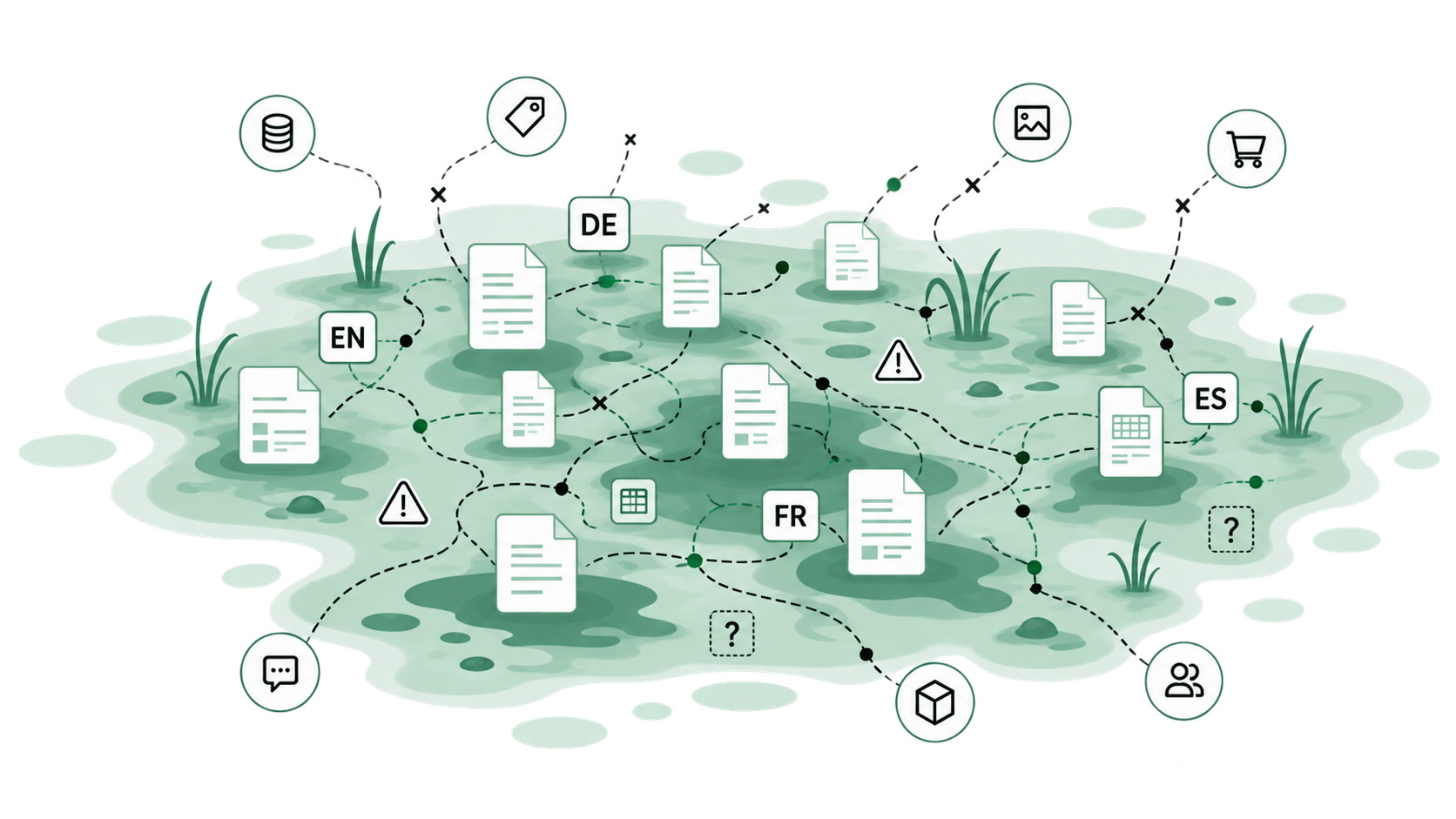
A useful test is simple: if an organization cannot trace an output back to its source, identify who or what changed it, determine which version is authoritative or understand which rules governed it, it has built storage, not yet a Language Lake.
A Language Lake can organize many different forms of context depending on the organization and use case. Two particularly useful frameworks are brand knowledge and regulatory knowledge.
Brand knowledge describes how an organization wants to communicate: terminology, tone, style, approved language and other brand rules.
Regulatory knowledge describes what an organization is required, permitted or forbidden to communicate. A sustainability claim may require specific evidence or wording, while products sold in different countries may be subject to different mandatory information or language requirements. In medical devices, for example, the EU MDR and IVDR include language requirements for information supplied with devices according to the Member State in which they are made available.
We think of these as a Brand Hub and a Regulatory Hub within the Language Lake. They are useful ways of structuring enterprise knowledge, but they are only two examples of the context that can influence content.
In a video game, for example, the translation of a character’s dialogue may depend on their age, personality, role and level of formality, but also on who they are speaking to and where the conversation occurs in the story. In other environments, the relevant context might instead come from a product configuration, customer profile, audience, previous interaction or business situation.
The principle is the same: the Language Lake should be able to capture and activate whatever context is needed to create, translate or transform a particular piece of content correctly.
As the cost of creating content falls, the cost of losing control over it can rise.
More people can create more content, through more systems, for more audiences and markets. Without shared governance, outdated information can be reused, AI output can be mistaken for validated material, terminology can become inconsistent and local-market knowledge can disappear from the central record.
A low-risk internal summary may be suitable for a highly automated workflow. A public sustainability claim, medical instruction or safety-critical technical procedure may require a very different combination of technology, evidence and specialist human review.
The important question is not simply whether AI can process the content. It is whether the chosen level of automation is appropriate for its purpose and potential impact.
This is why human language expertise must remain a core part of the architecture. Linguists, reviewers, local-market specialists and subject-matter experts do more than correct final outputs. Their terminology decisions, cultural knowledge, regulatory interpretations, quality judgments and approvals can become structured inputs that improve future workflows.
Few organizations will build a Language Lake across their entire enterprise in one project. They do not need to.
For many organizations, the most useful starting point is content and asset discovery.
What content already exists? Where is it stored? Which versions are authoritative? Which terminology and translation memories remain valuable? Who owns the assets? Where are important human decisions being lost? Which processes already work well? Where could multilingual AI genuinely create value?
One organization may begin with technical documentation. Another with regulated product content. Another with customer support or a specific multilingual AI application.
Existing TMS, CMS, PIM, DAM, enterprise data platforms and repositories can remain in place. The Language Lake can progressively connect the knowledge distributed across them and introduce new capabilities without requiring an immediate rip-and-replace program.
The goal is not to put AI everywhere. It is to put the right multilingual AI capability in the right place.
In this architecture, the TMS remains a highly specialized environment for translation and human review, CMS, PIM, DAM and other enterprise platforms continue to manage their respective content domains. And, the Language Lake provides the language intelligence layer that connects knowledge across them, linking translation, generation, search, content transformation, multimodal workflows and other enterprise applications.
Many of the ideas behind the Language Lake predate the latest generation of AI.
For years, teams across Powerling and CrossLang have worked on questions around contextual machine translation, multilingual data, NLP, human feedback, quality evaluation and content traceability. These subjects have also been part of our exchanges with clients, researchers, technology companies and industry communities such as LT-Innovate and the European Association for Machine Translation.
What has changed in the last few years is technical maturity. Modern retrieval, NLP, scalable data infrastructure and large language models make it increasingly practical to connect capabilities that previously existed as separate technologies, workflows or research problems.
Across different client environments, we have already built and deployed many of the capabilities that define a Language Lake in practice. This includes hyper-contextualized translation systems that combine linguistic assets, metadata, business context and regulatory rules to improve quality, enforce compliance and adapt content to specific markets, audiences or use cases.
These systems are already live in production, with human feedback, contextual retrieval, routing and governance progressively feeding into each client's language intelligence layer. In practice, we have already begun building Language Lake architectures progressively for multiple clients, each starting from a specific operational need rather than an organization-wide deployment.
The next generation of language technology will not be defined by a single LLM, translation engine or platform.
It will be defined by an organization’s ability to understand and control the language knowledge it already possesses, and to make that knowledge available wherever content is created, transformed or delivered.
This requires two complementary capabilities.
The first is memory: the ability to track, audit and master years of multilingual content, including valuable legacy assets that risk becoming invisible inside the current explosion of AI-generated material.
The second is activation: the ability to supply trusted, relevant context to generate, transform, translate, and personalize content.
The Language Lake becomes both the memory of the global organization and the context engine for its future communication.
If your organization is investing heavily in content but lacks full visibility, alignment, or scalability, it is time for a structured assessment.


.svg)


.svg)

.svg)





.svg)