.webp)
10.1.26
When AI Has to Slow Down | Carola Hahn-Auer and Ian Zhang
Read
Life Science
.svg)
.svg)
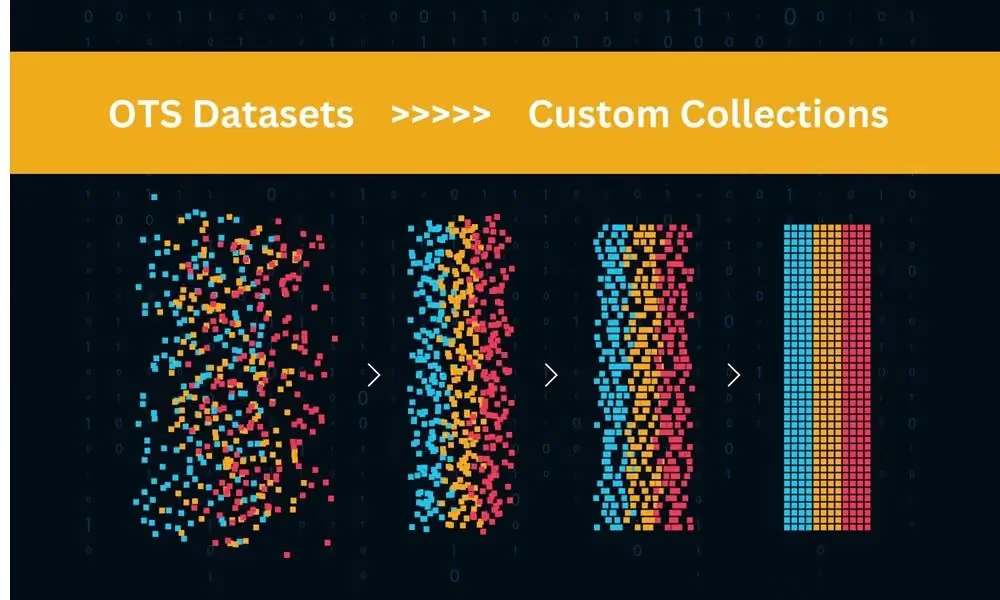
In the rapidly evolving world of data-driven businesses, thedemand for high-quality datasets is paramount. Whether it’s for machinelearning, natural language processing (NLP), or translation services, thequality and relevance of data directly impact the effectiveness of the modelsand services built upon them. Two primary types of datasets are often discussedin this context: Off-The-Shelf (OTS) datasets and custom collections. Understandingthe nuances between these two can help organizations like Powerling, whichspecializes in translation services, call center data, and voice recordings,make informed decisions about their data strategies.
Off-The-Shelf (OTS) datasets are pre-built collections ofdata that are readily available for purchase or use. These datasets aretypically created for broad applications and are often standardized to fit awide range of use cases. OTS datasets can include anything from languagecorpora, voice recordings, and text corpora to large-scale datasets used inmachine learning models.
OTS datasets are commonly used in applications wheregeneralization is key, such as training broad-based machine learning models,developing language models, and enhancing speech recognition systems. Forinstance, in translation services, an OTS dataset might include a generalcorpus of multilingual texts that can be used to train models capable oftranslating between multiple languages.
Custom collections are datasets that are specificallycreated or curated to meet the unique needs of a particular project ororganization. These datasets are tailored to address specific challenges,target particular languages, dialects, or industries, and are often developedwith a clear understanding of the end-use cases.
Custom collections are indispensable in scenarios wherespecificity and precision are critical. For example, in the context oftranslation services, a custom dataset might be developed to handle specificregional dialects or industry-specific jargon that would not be adequatelycovered by an OTS dataset. Similarly, in call center operations, customcollections might include voice recordings that reflect the specific accents,speech patterns, and customer interactions unique to a particular market.
OTS datasets are advantageous when quantity is a priority.They provide large volumes of data that can be used to train models at scale.However, the quality of this data in terms of relevance to specific tasks maynot always meet the mark. On the other hand, custom collections focus onquality, providing highly relevant and accurate data, though often in smallerquantities due to the bespoke nature of the collection process.
OTS datasets are ideal when speed is essential. They alloworganizations to quickly deploy models and services without waiting for datacollection and preparation processes. Custom collections, conversely,prioritize precision over speed. They are meticulously curated, which can delaydeployment but ultimately result in more accurate and effective models.
OTS datasets are generally more affordable due to theirmass-produced nature. For organizations working with tight budgets, OTSdatasets offer a way to access large amounts of data without significantinvestment. Custom collections, while more expensive, provide a higher returnon investment (ROI) in situations where the accuracy and relevance of data arecrucial to the success of the project.
For broad-based applications, OTS datasets are sufficient.They are perfect for developing general-purpose models or for use inenvironments where data needs are not highly specific. However, for specializedapplications—such as niche translation services or industry-specific languagemodels—custom collections are essential. They ensure that the data alignsperfectly with the specific needs of the project, resulting in better outcomes.
The choice between OTS datasets and custom collections isnot a one-size-fits-all decision. It requires careful consideration of thespecific needs of each project.
In scenarios where time and cost are critical, and theapplications are broad, OTS datasets provide a viable solution. They offerquick, cost-effective access to large volumes of data that can be easilyintegrated into existing systems.
However, when the stakes are high, and the precision of thedata is an overriding concern, such as when dealing with regional dialects,industry-specific jargon, or specific customer interactions - customcollections become indispensable. While they require more investment in termsof time and resources, the resulting data is far more aligned with the specificneeds of the project, leading to better performance and more accurate outcomes.
Ultimately, the key lies in understanding the specificrequirements of your project and choosing the dataset that best aligns withthose needs. By leveraging the strengths of both OTS datasets and customcollections, organizations can build robust, effective models and services thatmeet the diverse demands of their clients.
If your organization is investing heavily in content but lacks full visibility, alignment, or scalability, it is time for a structured assessment.


.svg)


.svg)

.svg)





.svg)