8.25.26
The Language Lake: The Foundation of Language Intelligence in the AI Era
Read
.svg)
.svg)
Managing product content in one language is already a challenge. Managing it across several markets, languages, channels and product lines is a different level of complexity.
For many retailers, manufacturers and e-commerce teams, Akeneo PIM is the central place where product information is structured, enriched and prepared for distribution. It helps teams manage product data before it is published to websites, marketplaces, catalogs, distributors and other sales channels.
But when a business expands internationally, that same product information needs to become multilingual.
Product names, descriptions, attributes, technical specifications, marketing copy, asset metadata and catalog content all need to be translated, adapted and kept up to date. And because product information changes constantly, translation cannot be treated as a one-off project.
It needs to become part of the product content workflow.
That is exactly where a connected Akeneo translation process can help.
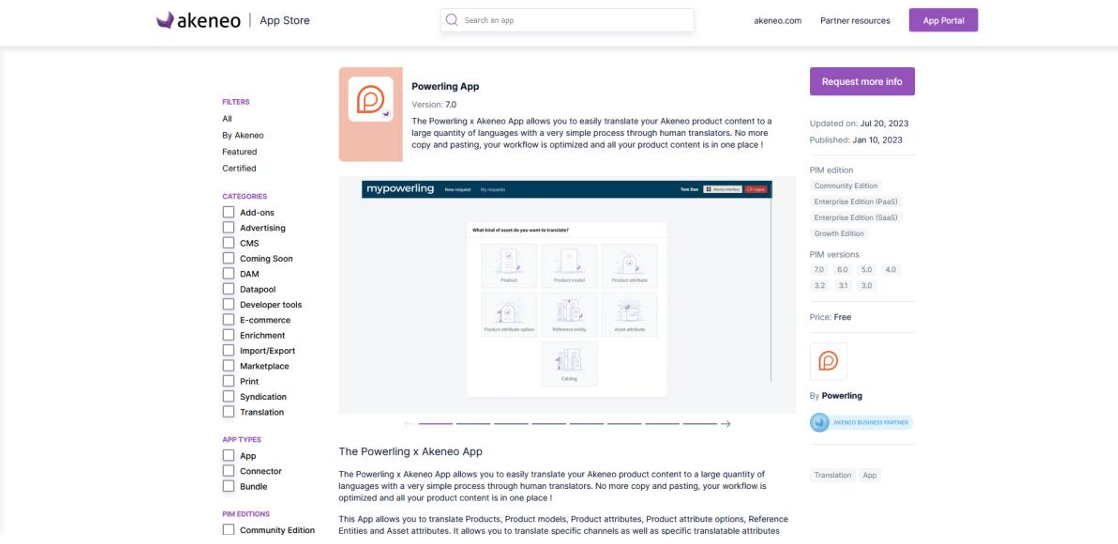
With the Powerling Akeneo app, product teams can connect their Akeneo environment to a dedicated Powerling translation platform, select the product content they want to translate, bundle it into translation requests and send it to Powerling for professional translation, human post-edited translation or AI translation.
The result is a smoother way to manage multilingual product content without copying and pasting data between disconnected tools.
A product catalog is not static.
New products are added. Attributes are updated. Descriptions are improved. New markets are launched. Product families evolve. E-commerce teams prepare seasonal campaigns. Marketplaces require specific fields. Internal teams need accurate multilingual data.
When translation is handled manually, teams often end up moving product content between spreadsheets, emails and translation files. This may work for a small number of products, but it quickly creates friction at scale.
The main risks are easy to recognize:
For international product operations, the issue is not only “how do we translate this content?” It is also “how do we make translation fit naturally into the way product information is already managed?”
That is why connecting translation to the PIM is so valuable.
Akeneo is where your product information lives. It remains the source of truth for your product data, product attributes, catalogs, channels and enrichment workflows.
The Powerling Akeneo app does not replace Akeneo. It connects to your Akeneo environment and gives your teams a dedicated space to prepare and manage translation requests based on the product information already available in the PIM.
This distinction matters.
The Powerling app is a dedicated third-party platform built by Powerling for Akeneo translation workflows. Once connected, it can access the relevant product information from Akeneo and allow users to select, group and send content for translation from a purpose-built translation interface.
This makes the workflow easier to manage because product teams do not need to copy content out of Akeneo manually, and localization teams do not need to reconstruct product context from disconnected files.
It also makes the integration more robust. Because the workflow is handled through a dedicated connected app rather than by relying on manual navigation or fragile interface workarounds, it is less exposed to day-to-day changes in the Akeneo user interface.
In simple terms:
Together, these tools create a more complete localization workflow.
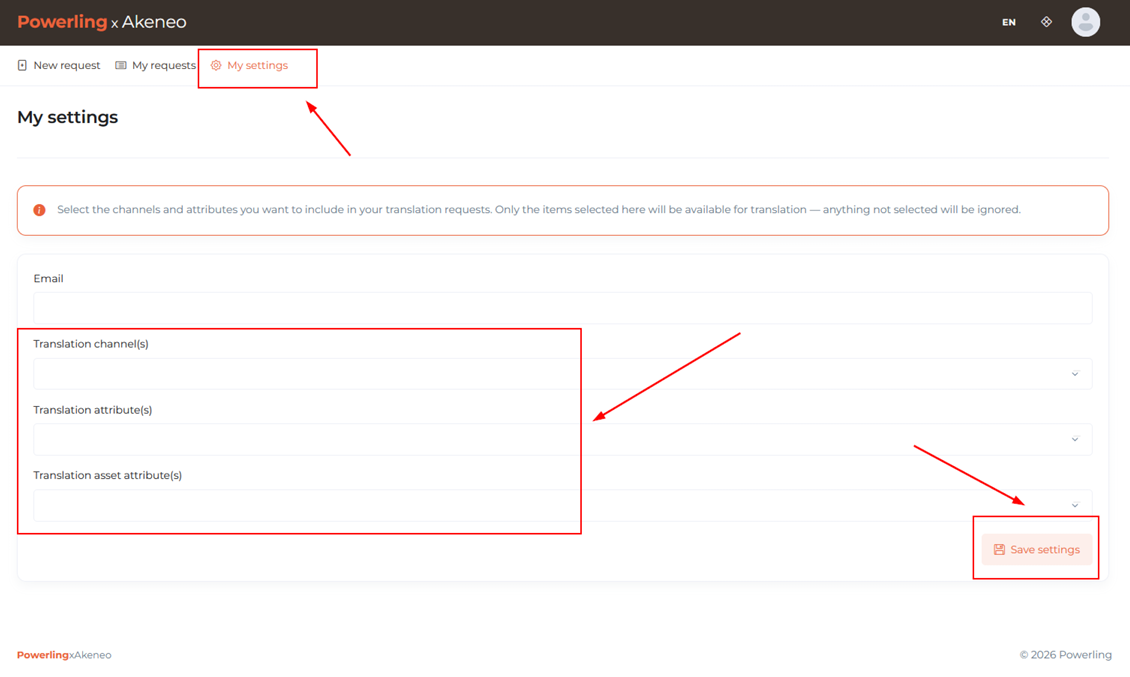
Every Akeneo environment is different. Some companies manage simple product descriptions. Others manage complex product families, rich technical attributes, digital assets and multiple channel-specific content structures.
A good translation workflow needs to respect that structure.
With the Powerling Akeneo app, teams can define which content should be included in translation requests. This can include product information, selected attributes, asset-related information, reference entities or catalogs depending on the setup and translation needs.
This flexibility is important because not every field should be translated in the same way.
For example:
By choosing the right content and grouping it properly, companies can avoid translating unnecessary fields while making sure high-value product information receives the attention it needs.
One of the key benefits of working with Powerling is the ability to adapt the translation approach to the content.
Not every product field needs the same level of human intervention. Not every market has the same commercial priority. Not every product category carries the same level of risk.
For Akeneo product content, Powerling can support three main translation approaches.
Human translation is the right choice when quality, accuracy and brand experience are critical.
This is often the best option for strategic product launches, premium collections, high-visibility product pages, technical content, regulated information and brand-sensitive descriptions.
Human translators bring context, judgment and market understanding. They can adapt phrasing, respect terminology, handle ambiguity and make sure the translated product content feels natural for the target audience.
For brands that care deeply about tone of voice, product storytelling or technical precision, human translation remains essential.
Human post-edited translation combines technology and linguistic expertise.
In this workflow, an initial translation is produced by machine translation or AI, then reviewed and improved by a professional linguist. The linguist corrects errors, improves fluency, checks terminology and ensures the final content is suitable for publication.
This can be a strong option for large product catalogs where speed and cost efficiency matter, but where the business still wants human quality control before publication.
For many e-commerce teams, human post-edited translation offers a practical balance: faster than fully human translation for large volumes, but safer and more controlled than raw automated output.
Full AI translation can be useful for high-volume, low-risk or time-sensitive content where speed is the main priority.
It may be appropriate for internal previews, early product enrichment, lower-visibility fields or content that will later be reviewed as part of a broader workflow.
The important point is that AI translation should be used strategically.
A strong localization workflow does not treat AI as a one-size-fits-all solution. It defines where AI is useful, where human review is needed and where fully human translation remains the best option.
This is especially important for product catalogs, where some fields are repetitive and structured while others directly influence brand perception, conversion or compliance.
The Powerling Akeneo app is designed to simplify how product content is selected and sent for translation.
Once connected to Akeneo, the app gives teams a dedicated interface where they can view relevant product information, select the content they want translated and create translation requests.
Instead of preparing files manually, users can work from the product data available in their PIM environment.
A typical workflow can look like this:
This gives product and localization teams a clearer process from request creation to delivery.
It also makes translation easier to organize around real business needs.
For example:
Instead of treating translation as an external file task, teams can manage it as part of their product content operation.
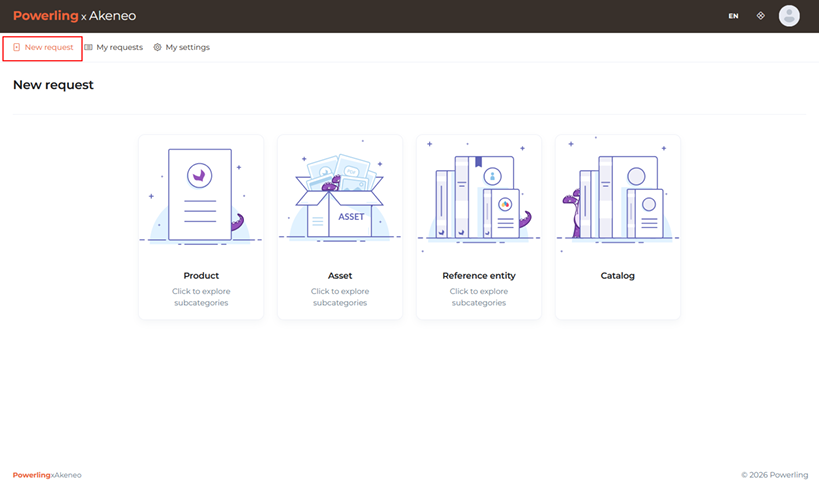

For large product ranges, translation often needs to happen in structured batches.
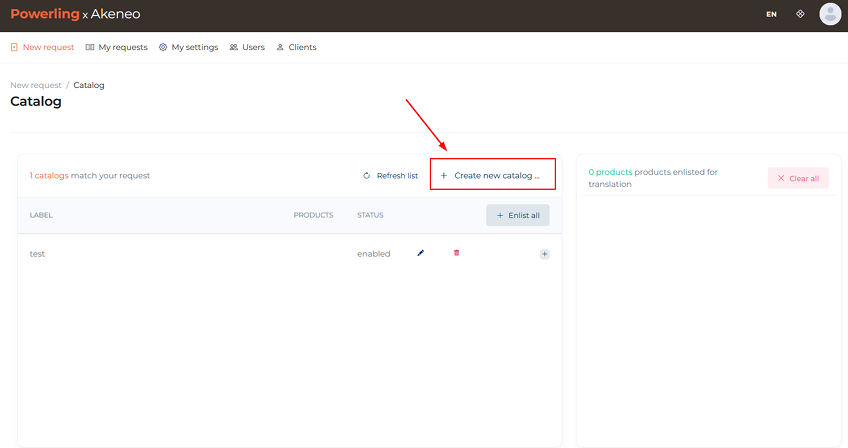
This is where catalogs are especially useful.
Catalogs can help teams group products by market, channel, category, campaign, product family or any other relevant business criteria. This makes it easier to send the right content for translation at the right time.
For example, a business could create a translation request for:
This approach helps localization follow the rhythm of the business.
Rather than translating everything at once or manually selecting products from spreadsheets, teams can organize requests around meaningful product groups.
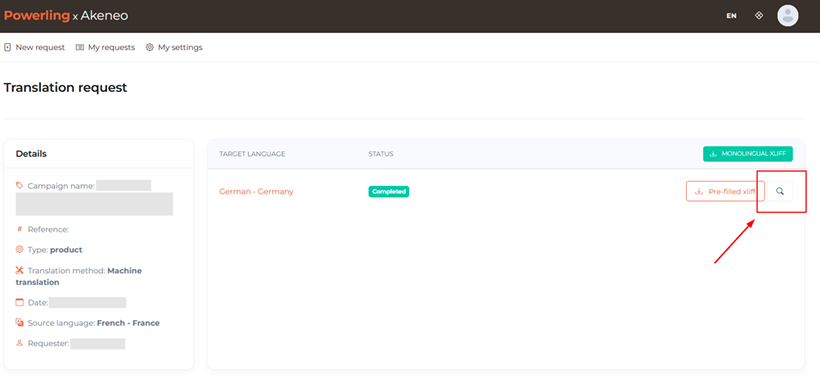
Translation workflows need control.
Before translated content is pushed back into the PIM, teams should be able to review what has been delivered and confirm that it is ready.
With the Powerling Akeneo app, translated content can be reviewed before it is pushed back to Akeneo. This gives teams an additional layer of visibility and helps ensure that the content returning to the PIM is ready to be used across channels.
This is particularly important when several target languages are involved.
A product launch may be ready in German but still pending in Spanish. A technical review may be required for one market but not another. A team may want to validate content before it is distributed to the website or marketplace feeds.
A connected workflow gives teams a clearer view of progress and reduces the uncertainty that often comes with manual file exchange.

The Powerling Akeneo app is focused on product content selection and translation request creation from the PIM environment.
MyPowerling plays a different role.
It is Powerling’s customer portal for managing the wider translation process. Through MyPowerling, clients can track translation requests, approve quotes, manage files, download completed deliverables and follow project activity more broadly.
This matters because not everything belongs inside Akeneo.
Akeneo is the right place to manage product information. The Powerling Akeneo app is the right place to prepare and send product translation requests linked to Akeneo content. But cost management, quote approval, file exchanges, custom workflows and broader project tracking often need a dedicated customer portal.
That is where MyPowerling adds value.
For example, a product manager may initiate a translation request from the Akeneo-connected app. A localization manager or project stakeholder may then use MyPowerling to approve the quote, follow the translation process, access related files or manage a more customized workflow.
This creates a clearer separation of roles:
Together, they create a more complete localization ecosystem for companies managing multilingual product content at scale.
International e-commerce depends on both speed and quality.
If translations take too long, market launches are delayed. If translations are inconsistent, the customer experience suffers. If teams rely too heavily on manual workflows, product updates become harder to manage.
A connected Akeneo translation process helps teams work more efficiently.
It helps teams:
For businesses managing frequent catalog updates, multiple markets or large product ranges, this can make localization much easier to scale.
One common mistake is treating product translation as a file export problem.
Exporting and importing files can work for occasional projects, but it becomes harder to manage when content changes frequently or when several teams are involved. A connected workflow helps reduce that manual burden.
Another mistake is translating every field with the same method.
Some content deserves fully human translation. Some content is suitable for human post-edited translation. Some content may be appropriate for AI translation. Applying the same model to everything can either increase cost unnecessarily or create quality risks.
A third mistake is translating content without clear terminology.
Product catalogs depend on consistency. Materials, features, product families, technical terms and brand expressions should be translated in a controlled way across languages and channels.
Finally, many teams focus on the initial international launch but forget about ongoing updates.
A multilingual catalog needs to stay synchronized with the source catalog over time. When product content changes, the localization workflow needs to be ready to handle those updates efficiently.
The best way to translate an Akeneo catalog is to keep translation connected to product information management.
That means using Akeneo as the product content source of truth, using a dedicated connector to prepare translation requests, choosing the right translation method for each content type and managing the wider translation process through a platform such as MyPowerling.
For a small catalog, this may mean sending carefully selected product content for human translation.
For a larger catalog, it may mean combining human translation, human post-edited translation and AI translation depending on content type, market priority and quality requirements.
For complex international operations, it may also involve catalogs, custom workflows, quote approvals, file management and API-based automation.
The right workflow depends on the business, but the objective is always the same: make multilingual product content easier to create, easier to manage and easier to trust.
Akeneo helps businesses structure and manage product information.
Powerling helps make that product information multilingual.
With the Powerling Akeneo app, teams can connect their Akeneo environment to a dedicated translation workflow, select product content, choose the right translation method and manage multilingual product requests more efficiently.
With MyPowerling, clients can also manage the broader translation process, including quotes, files, project tracking and custom workflows.
Together, these tools help international teams move from manual translation management to a more connected localization process.
If your business is expanding across markets, your product content needs to travel with you.
Powerling can help you translate, manage and scale your Akeneo product catalog for every market you serve.
Akeneo product translation is the process of translating and localizing product information stored in Akeneo PIM, such as product names, descriptions, attributes, asset information, reference entities and catalog content.
Yes. With the Powerling Akeneo app connected to your Akeneo environment, teams can select product content, group it into translation requests and send it to Powerling without manually copying content into separate files.
Powerling can support human translation, human post-edited translation and full AI translation. This allows teams to choose the right workflow depending on the content type, volume, quality expectations, timing and budget.
The Powerling Akeneo app is used to connect Akeneo product content to translation requests. MyPowerling is Powerling’s customer portal for managing the wider translation process, including project tracking, quote approval, file management and downloads.
Yes. Product content can be organized and selected according to business needs, such as product category, market, channel, collection, product family or launch priority. This makes it possible to translate the right content at the right time.
If your organization is investing heavily in content but lacks full visibility, alignment, or scalability, it is time for a structured assessment.


.svg)


.svg)

.svg)





.svg)